

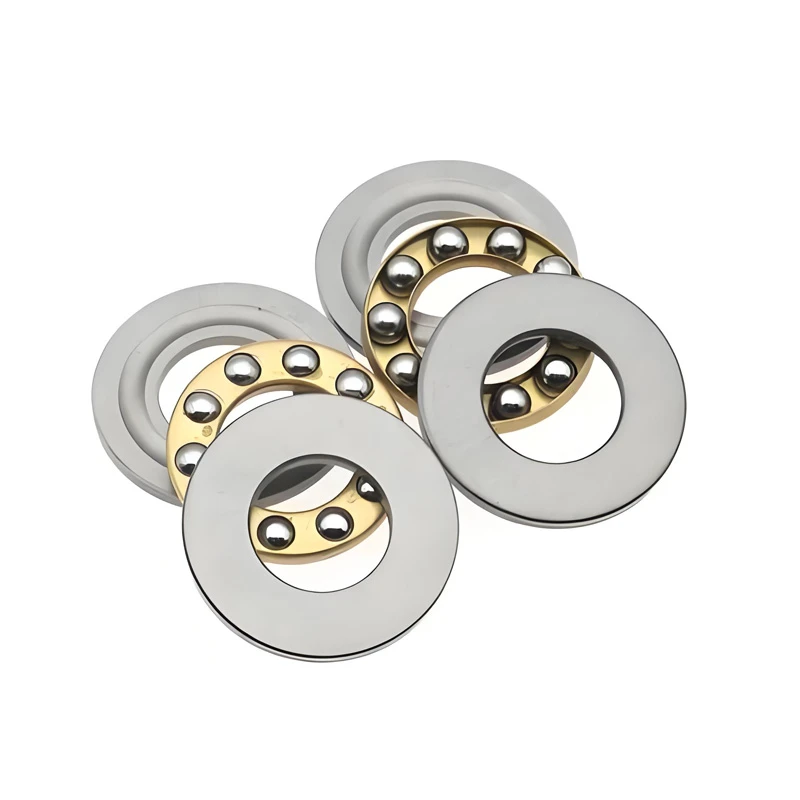
What determines the service life of flat pressure thrust ball bearings? Does it merely depend on the quality of the product itself? The answer is no. It is more closely related to whether the installation is standardized and the maintenance is in place. Many times, is the root cause of equipment failure the insufficient performance of the bearings? Not really. It is often due to the neglect of details in installation and maintenance. So, how can we make flat pressure thrust ball bearings fully utilize their performance and avoid unnecessary wear and tear? The answer lies in mastering the correct operating methods.
What preparations are needed before installing flat pressure thrust ball bearings? This is the foundation for ensuring subsequent operation. First, inspect the appearance of the bearing. How? Confirm that there are no cracks, rust, or foreign matter attached to the fixed ring, floating ring, and rolling elements. If oil stains are found on the surface, what should be done? Wipe it clean with clean kerosene or a special cleaning agent to prevent foreign matter from affecting the bearing operation. At the same time, what are the requirements for the installation site? Ensure that the shaft shoulder and the end face of the bearing seat are flat without burrs, and the dimensions match the bearing specifications. What will happen if the diameter of the shaft shoulder is too large? It will cause the fixed ring to fail to fit tightly. If the end face of the bearing seat is uneven, what will occur? It will cause the floating ring to be unevenly stressed, and both situations will shorten the service life of the flat pressure thrust ball bearings. In addition, how should the installation tools be selected? Use copper rods or special sleeves to transmit force. Why can't the bearing be directly struck with a hammer? This prevents deformation of the rolling elements or the inner and outer rings due to impact.
What are the key points during the installation process? Pay attention to "precise alignment" and "even force application". When fitting the fixed ring of the flat pressure thrust ball bearing onto the shaft, what should be done? Ensure that the fixed ring fits tightly against the shaft shoulder without any gaps. After the floating ring is installed in the bearing seat, what operation needs to be carried out? Adjust the position to ensure the parallelism between the floating ring and the fixed ring. What will be the consequence if the parallelism deviation is too large? It will cause uneven stress on the rolling elements and accelerate wear. For scenarios where the bearing needs to withstand large axial loads, how should it be handled during installation? Elastic shims can be added between the bearing and the bearing seat to provide a buffering effect, but what is the requirement for the thickness of the shims? It needs to be moderate; if it is too thick, it will affect the stability of the bearing. After the installation is completed, what inspection should be carried out? Manually rotate the shaft to check whether the bearing operates flexibly, without any jams or abnormal noises. Proceed with subsequent assembly only after confirming that everything is okay.
How important is daily maintenance for flat pressure thrust ball bearings? It is a crucial link in extending the bearing's service life. During the operation of the bearing, why is it necessary to regularly replenish the lubricating grease? Because the lubricating grease can reduce the friction between the rolling elements and the inner and outer rings, and at the same time, it plays a role in dust prevention and rust prevention. What are the precautions when replenishing the lubricating grease? Select a type that is suitable for the bearing's working conditions. For example, use high-temperature-resistant lubricating grease in high-temperature environments, and the amount should not be excessive. Otherwise, what problem will occur? It will increase the operating resistance of the bearing and generate excessive heat. In addition, what other work is involved in daily maintenance? Regularly clean the foreign matter around the bearing. Why? To prevent dust, iron filings, and other foreign objects from entering the bearing, causing scratches on the rolling elements or damage to the cage. If the equipment is used in a wet or corrosive environment, how should the bearing be protected? Install a sealing device for the flat pressure thrust ball bearing to reduce the intrusion of corrosive media. When it is found that the bearing's operating noise increases, the axial play becomes significant, or the temperature rises abnormally, what should be done? Stop the machine in a timely manner for inspection, and replace the flat pressure thrust ball bearing with a new one if necessary to avoid the expansion of the failure and affect the operation of the entire equipment.


